










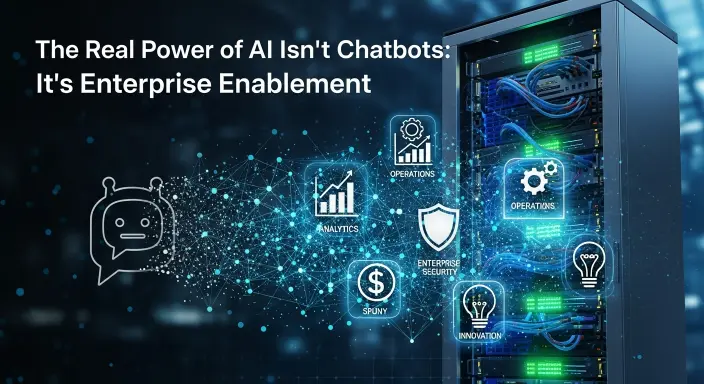
Introduction: Why New Tech Gets Misunderstood First
When a new technology arrives, people often understand it through old analogies.
That’s why consumer chatbots became the first breakout use case: they feel like a replacement for Google, social media, or messaging.
But the clip’s main point is clear:
Using AI as a drop-in replacement is only a tiny fraction of what it can do.
1) Chatbots Were the “Easy Analogy,” Not the Endgame
According to the speaker, consumer chatbots took off first because they match familiar behaviors:
- searching for answers
- browsing information
- interacting like social platforms
That makes adoption fast—but it also limits imagination.
Key idea: The first popular use case is rarely the most powerful one.
2) The Ultimate Power of AI: Enabling Economic Activity
The speaker frames AI’s “real” power as something broader:
- enabling businesses
- accelerating economic activities
- integrating into how organizations operate
This is a shift from “AI as a product” to AI as infrastructure.
3) Why Some AI Companies Focus on Enterprise
The clip contrasts consumer-first strategies with an enterprise-first approach:
- some major companies push consumer direction
- the speaker describes a desire to serve enterprises and business use cases
Translation: The biggest AI impact won’t just be apps—it’ll be workflows.
4) Why Code Became the First Massive Business Use Case
The speaker is excited about code—but makes a specific argument:
It’s not that code is uniquely perfect for AI.
It’s that developers adopt new tools faster because:
- they’re early adopters
- they’re close to the LLM revolution
- the “diffusion” (spread) is faster in that community
Big takeaway: Code is the first visible win because adoption friction is low.
5) The Same Value Could Hit Every Industry—But Friction Is the Barrier
The clip lists multiple domains where AI could deliver huge value, but faces more friction:
- financial services
- sales and marketing
- pharma and biomed
- legal productivity
- manufacturing
- basically “across the board”
The argument is blunt:
We’re not held back by AI capability. We’re held back by practical integration problems.
6) What “Friction” Actually Means in Enterprise AI
The speaker describes a real-world challenge:
Big companies that “do something other than AI” must:
- mesh their existing systems
- integrate workflows
- solve practical operational issues
- make AI fit into the org safely and reliably
This is why adoption looks uneven.
7) The Pattern to Watch: Internal Product-Market Fit
A key moment in the clip is the story about how a big product signal appeared:
- early 2025: leadership encouraged internal experimentation to improve productivity with their own AI
- an internal command-line coding tool spread rapidly inside the company
- within weeks, a large fraction of employees were using it
- that rapid adoption became the strongest signal
- the team decided to release it publicly because it showed clear product-market fit
Core lesson: Internal product-market fit can be the best early indicator of a successful AI product.
8) “Move Fast” (With One Condition)
The speaker’s rule is essentially:
If something:
- appears safe
- has product-market fit (even internal)
…then you should scale it as fast as possible.
Safety and moral concerns are treated as a separate gate.
Conclusion: The Next AI Wave Is Not a Better Chatbot
This clip is basically a warning and a roadmap:
- chatbots are the first analogy, not the final form
- the deepest AI value is enterprise enablement
- code led the way because adoption friction was low
- the next breakthroughs will come from reducing friction in industries like finance, legal, and manufacturing
- internal adoption signals can reveal winners early
FAQ (SEO)
Why did chatbots become the first AI breakout product?
Because they resemble familiar tools like search and social platforms, making them easy to understand and adopt.
What does “AI enabling businesses” mean?
Using AI to accelerate workflows, productivity, and operations across industries—not just answering questions.
Why is coding the first major enterprise AI use case?
Developers adopt new tools quickly and are closer to the AI ecosystem, so diffusion happens faster.
What’s the biggest barrier to AI adoption in other industries?
Not AI power—integration friction: systems, workflows, governance, and practical deployment challenges.