













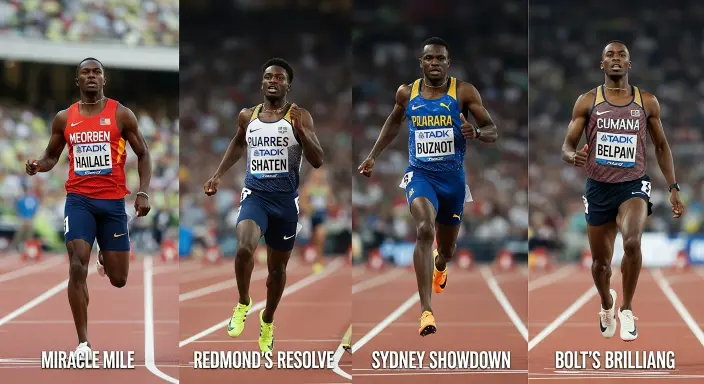
Legendary Moments That Defined Athletics
There is something universally captivating about a comeback. It’s not just about speed or strength—it’s about resilience, timing, and the refusal to surrender when defeat seems inevitable. In track and field, where races are often decided by fractions of a second, comebacks represent the purest form of competitive spirit.
These moments go beyond medals. They redefine careers, inspire generations, and remind us why athletics remains one of the most emotionally powerful sports in the world.
In this article, we explore some of the greatest comeback performances in track and field history—races where athletes overcame impossible odds to achieve greatness.
Why Comebacks Are the Most Powerful Moments in Athletics
Track and field is unique because every athlete competes against three opponents at once:
- Their competitors
- The clock
- Their own physical limits
Comebacks represent the moment when an athlete transcends all three.
Unlike dominant victories, comeback wins carry uncertainty. They unfold in real time, building tension with every stride. The athlete who was once trailing suddenly finds another gear, accelerating past exhausted competitors to seize victory.
These performances often define legacies.
Paul Ereng’s Devastating Finish: The 1989 World Indoor Championships
Paul Ereng’s rise to global prominence was not immediate. Originally a 400-meter runner, he transitioned to the 800 meters in 1987—a decision that would transform his career.
By the time he reached the 1989 World Indoor Championships in Budapest, Ereng had already demonstrated his ability to deliver explosive finishes. However, his defining moment came during the 800-meter final.
The Race Strategy That Changed Everything
Ereng employed a calculated strategy. Instead of leading early, he allowed competitors to set the pace while conserving energy. For much of the race, he remained behind the leaders, appearing out of contention.
Then, in the final stretch, everything changed.
He unleashed a devastating acceleration, overtaking runner after runner. His closing speed stunned both competitors and spectators. He crossed the finish line with a time of 1:44.84, setting a new world indoor record.
This performance demonstrated a critical truth in middle-distance racing: victory is often decided in the final seconds, not the opening laps.
Mike Franks and the 1985 World Cup Relay Comeback
Relay races introduce another dimension: teamwork. A single mistake can cost victory, but a single athlete can also save the team.
During the 1985 Athletics World Cup, the United States held a narrow lead heading into the 4×400 meter relay. However, chaos erupted during the baton exchange.
Disaster Strikes
Interference from a rival runner disrupted the handoff, causing confusion and forcing American anchor runner Mike Franks to recover the baton under pressure.
Instead of starting with an advantage, Franks found himself trailing in fourth place.
For many athletes, this moment would have signaled defeat.
For Franks, it became motivation.
A Legendary Anchor Leg
Franks delivered one of the fastest anchor legs ever recorded, clocking an astonishing 44.2 seconds. His powerful sprint allowed the United States to recover from disaster and secure a dramatic victory.
This performance remains one of the greatest relay comebacks in track and field history.
Andrew Lloyd’s Emotional Victory: The 1990 Commonwealth Games
Andrew Lloyd’s comeback story extended beyond a single race. It was a comeback from personal tragedy.
After surviving a devastating car accident that left him severely injured and emotionally shattered, Lloyd faced uncertainty about his athletic future.
Many believed his career was over.
They were wrong.
The 5,000-Meter Final
During the 1990 Commonwealth Games in Auckland, Lloyd faced a field dominated by elite Kenyan runners, including Olympic champion John Ngugi.
With one lap remaining, Lloyd trailed significantly. Ngugi appeared certain to win.
But Lloyd refused to accept defeat.
He accelerated with relentless determination, gradually closing the gap. In the final meters, he overtook Ngugi to win gold with a lifetime best performance.
This victory represented not just athletic achievement, but personal redemption.
Floria Guei’s Stunning Relay Finish: European Championships 2014
Not all comeback heroes begin as favorites. Sometimes, they emerge unexpectedly.
At the 2014 European Championships in Zurich, the French women’s 4×400 meter relay team faced strong competition from established powers.
When Floria Guei received the baton for the final leg, France was in fourth place and nearly one second behind.
In elite sprinting, that margin is enormous.
The Final Sprint That Changed Everything
Guei maintained composure. Instead of panicking, she focused on rhythm and efficiency.
Gradually, she gained ground.
Her acceleration intensified in the final straightaway. One by one, she overtook competitors.
In the final steps before the finish line, she surged into first place, delivering one of the most dramatic relay finishes in modern athletics.
Her performance instantly became legendary.
The Science Behind Comeback Performances
Comebacks are not accidental. They result from a combination of physical preparation and mental strength.
Key factors include:
Energy Conservation Strategy
Athletes who conserve energy early can unleash stronger finishes.
Mental Resilience
Belief and focus allow athletes to push beyond perceived limits.
Race Awareness
Understanding pace, positioning, and timing is critical.
Anaerobic Power
The ability to accelerate when muscles are fatigued separates champions from competitors.
These elements combine to create comeback opportunities.
Why These Moments Matter Beyond Sports
Comeback stories resonate because they reflect universal human experiences:
- overcoming adversity
- recovering from setbacks
- refusing to quit
- achieving success despite doubt
These moments inspire athletes and non-athletes alike.
They demonstrate that circumstances do not define outcomes—determination does.
The Lasting Legacy of Track and Field Comebacks
Track and field has produced countless remarkable performances, but comeback victories remain among the most memorable.
They remind us that races are not decided until the finish line is crossed.
They teach us that resilience can overcome disadvantage.
And they prove that greatness often emerges in the moments when defeat seems certain.
Conclusion: The True Meaning of a Comeback
The greatest comeback performances in athletics represent more than physical ability. They symbolize perseverance, courage, and the refusal to accept limitations.
Whether it’s Paul Ereng’s record-breaking surge, Mike Franks’ relay recovery, Andrew Lloyd’s emotional triumph, or Floria Guei’s stunning sprint finish, these moments continue to inspire new generations.
In track and field—and in life—the race is never truly over until the very end.