The study that puts numbers to the extreme heat in Spain
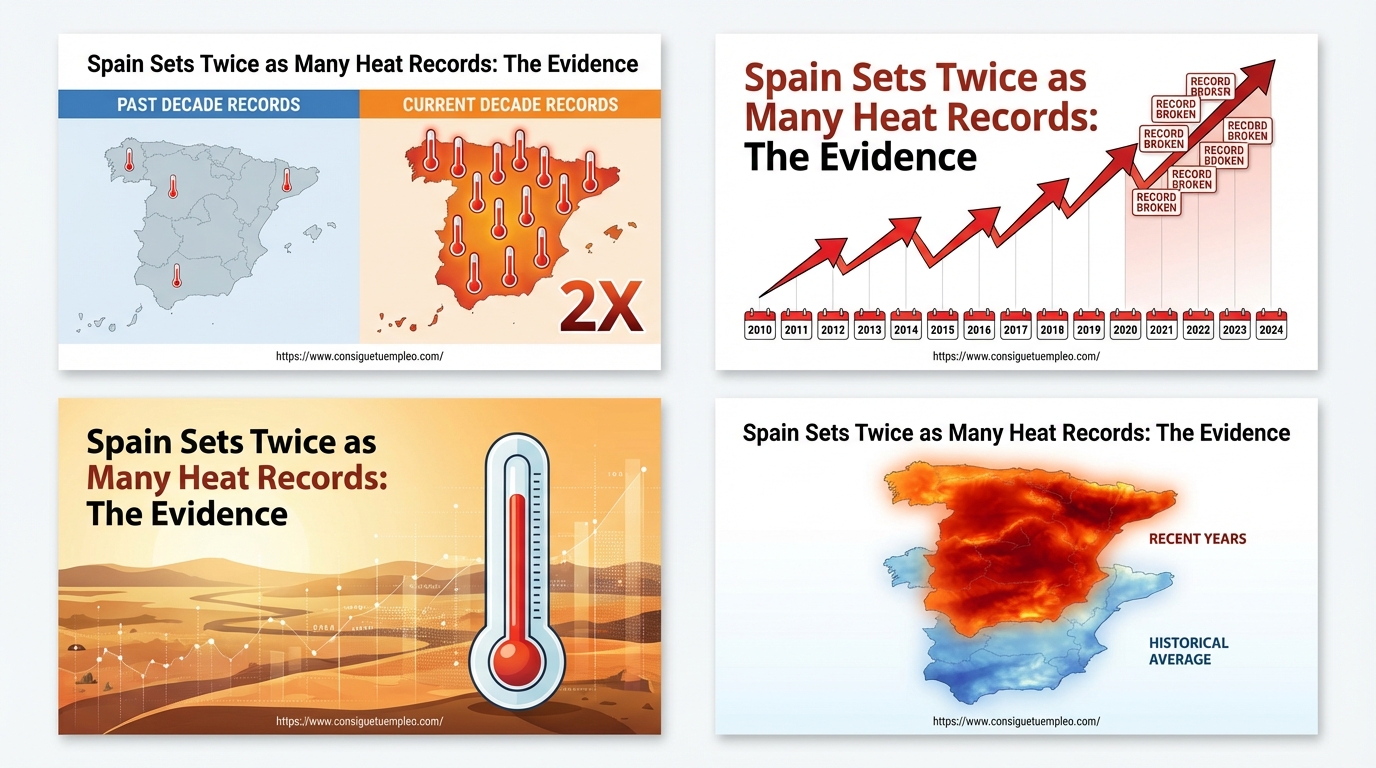
The collective intuition was right: it’s getting hotter in Spain , and extreme temperatures are becoming more frequent. But now there’s math behind that perception. Researchers at the University of Zaragoza analyzed historical temperature data from 1960 to 2021 and reached a compelling conclusion: heat records have doubled during that period. This isn’t just a feeling; it’s advanced statistics.
This work is not just another climate report. What sets it apart is its methodology: an advanced Bayesian model capable of filtering out the statistical noise inherent in six decades of data. This allows for the identification of real trends without isolated events or irregularities in data collection distorting the analysis. The result is a precise map of how and where extreme temperatures have changed across Spain, and the model has received international scientific awards.
What the Bayesian model says and why it matters
Bayesian models are not new to data science, but their application to long-term climate analysis represents a significant methodological leap. Unlike traditional frequentist approaches, the Bayesian approach incorporates prior knowledge and updates probabilities as new data become available, making it particularly robust for detecting structural changes in long time series.
 Do you want to go beyond the news?
In our community, we discuss trends, share opportunities, and support each other as entrepreneurs. No hype, just action.
In this case, the model allowed researchers in Zaragoza to separate natural climate variability from the signal attributable to anthropogenic global warming . The result: the frequency of new maximum temperature records doubled during the study period, with a particularly notable acceleration in the last two decades of the analysis.
The model is available for international scientific use, making it a replicable tool for other countries or regions that want to apply the same statistical rigor to their own historical series.
The hardest hit areas: Meseta Norte and Madrid lead the change
Not all of Spain is warming uniformly. The study’s geospatial analysis identifies the Northern Plateau and the Community of Madrid as the regions where the increase in the frequency of record-breaking heat has been most pronounced. These areas, historically characterized by hot, dry summers, are experiencing an intensification that exceeds known historical variability.
This coincides with data from the State Meteorological Agency (AEMET) , which documents how, since 1975, Spain has recorded 77 heat waves , five of which showed temperature anomalies exceeding 4°C . And all of these extreme heat waves have been concentrated in recent decades.
Related Content:
U.S. Dismantles NCAR: The Nation’s Top Climate Lab
The broader context: a decade that breaks all boundaries
Data from the last decade reinforces what the University of Zaragoza study mathematically confirms:
- The average temperature in Spain has risen 1.5°C since 1961 , with the 10 warmest years in modern history all occurring in the 21st century .
- 2022 was the warmest year on record, with an average temperature of 15.3°C and 41 days of extreme heat , seven times more than in the period 1981–2010.
- 2023 was the second warmest, with 44 record warm days and zero record cold days.
- In the first three years of the 2020s, almost twice as many days with temperatures of 40°C or more were recorded as in the entire 2010s.
- The absolute temperature record in Spain is held by Alcantarilla (Murcia) with 47°C recorded in 2021.
Heat waves are also getting longer: they last 3 additional days for every decade that passes, affect 3 more provinces each decade and are 2.7°C more intense per ten-year period, according to AEMET reports.
Why this matters to the entrepreneurial and technological ecosystem
It may seem like a topic far removed from the startup world, but climate data is becoming increasingly relevant for business decisions. Climate change is already redefining entire sectors: agritech , insurtech , renewable energy , urban infrastructure , and even logistics are being directly impacted by the frequency and intensity of extreme heat events.
For founders working on sustainability solutions, environmental data analysis, or predictive models , these types of studies serve as a wake-up call: there is a growing demand for tools that help companies, governments, and cities anticipate climate scenarios with greater accuracy. The availability of the Bayesian model developed in Zaragoza for international scientific use also opens up opportunities for collaboration and the development of products based on sound methodological foundations.
Climate data is data. And data, when interpreted correctly, is a competitive advantage.
Conclusion
The research from the University of Zaragoza doesn’t reveal anything that everyday experience wasn’t already suggesting: summers in Spain are more extreme, their peaks are more frequent, and they’re harder to ignore. What the study does offer is something the entrepreneurial ecosystem values above all else: rigorous evidence . An advanced mathematical model that transforms perception into statistical certainty and, moreover, can be replicated globally.
Understanding climate trends isn’t just the responsibility of scientists. It’s also fertile ground for founders who want to build relevant solutions for the next twenty years. The math behind climate change is already there.