










A Clear Cost Breakdown (Subscription vs Hybrid vs Gold OA)
Introduction: The Biggest Myth About Open Access
“Open Access publishing is expensive.”
You’ve heard it in academic circles, editorial meetings, and university budget discussions. Many researchers feel frustrated trying to find funds to cover publication fees.
But here’s what the cost comparisons suggest:
Open Access isn’t driving costs up. It can drive costs down—sometimes dramatically—depending on the model.
This article breaks down the three main publishing models and what the numbers imply for institutions, libraries, and researchers.
What Is Open Access Publishing?
Open Access (OA) publishing means a research article is available to read online without a paywall. Instead of readers paying via subscriptions, the cost often shifts toward publication fees (commonly called APCs, Article Processing Charges).
The controversy is simple:
- Subscription model: institutions pay to read
- Open Access model: institutions (or authors/funders) pay to publish
- Hybrid model: institutions may pay to read and pay to make some articles open
So which one is actually more expensive?
The 3 Main Publishing Models Explained
1) Subscription Journals
In the subscription model, institutions pay recurring fees for access. Articles remain behind paywalls unless separately purchased.
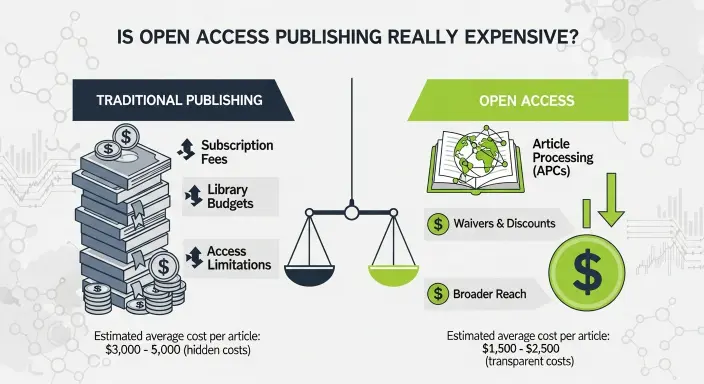
Estimated cost range to publish one article (societal cost):
- roughly $4,000 to $9,500 per article (as cited in bibliometric discussions and publisher reporting)
This range varies depending on discipline, journal operations, and publisher structure.
2) Hybrid Open Access
A hybrid journal is still subscription-based, but authors can pay an APC to make a specific article open immediately.
Average APC commonly cited in hybrid publishing:
- around $3,400 per article
Hybrid is often criticized because it can create “double payment” dynamics: pay to read and pay to publish open.
3) Gold Open Access
Gold OA journals publish content openly by default. The primary funding mechanism is usually APCs (though some are subsidized or diamond OA).
Average APC often cited for gold OA:
- around $2,300 per article
In many comparisons, pure gold OA publishers show a lower cost per article than subscription publishing.
Cost Comparison Summary: Subscription vs Hybrid vs Gold OA
When you visualize these models side-by-side:
- Subscription articles tend to sit in a higher cost band (roughly $4,000–$9,500/article)
- Hybrid APCs average around $3,400/article
- Gold OA APCs average around $2,300/article
A key takeaway from the argument is that gold OA can be 2–3× cheaper per article than subscription publishing on a per-article basis (depending on which estimates you use and how “cost per article” is defined).
The Big Institutional Question: What If Everything Shifted to OA?
One of the strongest claims in the talk is this:
If a large share of articles currently published under the high-cost subscription band moved into hybrid and gold OA price ranges, the system could see multi-billion-dollar reductions in total publishing expenditures.
The figure referenced suggests savings “on the order of” $7 billion in year one in a scenario of large-scale transfer (presented as an accounting-style estimate).
In other words:
The perception is “OA adds cost.”
The counterclaim is “OA exposes costs and can reduce the total.”
Why Do People Still Think Open Access Costs More?
If the numbers point toward OA reducing cost per article, why does the “OA is expensive” narrative survive?
1) Open Access makes costs visible
Subscription spending is often bundled into large institutional deals and multi-year contracts. Many communities don’t see a clear “per article” cost.
OA shifts the payment into something far more visible: a line-item APC.
Visibility feels like an increase—even when it replaces hidden spend.
2) Library budgets are constrained
Libraries often operate with flat or slow-growing budgets. If a university must keep paying subscriptions while also paying APCs, OA looks like an “extra” cost.
This is especially true during transitional periods when institutions are paying for both models simultaneously.
3) “Transformative agreements” can be complex
Many institutions report difficulties funding large agreements, forecasting publishing volume, and managing invoices.
So even if OA can lower costs in theory, implementation friction can make it feel more expensive in practice.
The Quality Concern: Can Costs Drop Without Hurting Peer Review?
A major point made is that responsible publishers argue there is a minimum cost threshold below which quality would suffer.
Why?
Because quality publishing requires:
- research integrity screening
- editorial coordination
- peer review operations
- technology platforms and workflows
- production, indexing, compliance support
The argument is not “cut costs at any price,” but “increase efficiency without damaging quality.”
A Practical Fix: “One Fee, Unlimited Publishing” Models
A proposed solution in the talk is shifting from unpredictable APC-per-paper payments to simpler institutional models.
The idea:
- institutions pay one annual fee
- publishing becomes unlimited for that institution’s researchers
- the cost becomes predictable and fits budget cycles
- authors avoid handling invoices
These agreements are positioned as:
- simpler
- more transparent
- lower administrative hassle
- better oversight via dashboards and real-time tracking
What Needs to Change Next
According to the argument presented:
- Legacy publishers need to be more transparent about pricing and cost logic
- funders and policymakers should pressure the ecosystem toward clarity
- libraries and institutions need models that avoid paying twice (read + publish)
Because the real blocker isn’t only cost—it’s the transition mechanics.
Conclusion: Is Open Access Publishing Expensive?
Open Access can feel expensive because APCs are visible and immediate.
But cost comparisons often suggest:
- gold OA can be cheaper per article than subscription publishing
- shifting models could reduce total system spend
- the biggest challenge is the transition period and transparency across publishers
The bottom line:
Open Access is not automatically “more expensive.”
In many comparisons, it’s part of the solution to lower publishing costs—without sacrificing quality.
FAQ (SEO Boost)
Is open access publishing always cheaper?
Not always. It depends on the journal, APC level, and whether institutions are still paying large subscription bundles at the same time.
Why do researchers say open access is expensive?
Because APCs are paid upfront and are personally visible to authors, even if they replace hidden subscription spending.
What’s the difference between hybrid and gold open access?
Hybrid is a subscription journal with optional APCs for individual articles. Gold OA is fully open by default.
Can OA reduce total publishing costs?
Many analyses and cost comparisons argue it can—especially if it replaces high-cost subscription spending rather than stacking on top of it.